Plastic FinanceToken for plastic recycling

Overview
Plastic creates a problem 400 years i.e. 16 generations. 91% not recycled ultimately affects us and the environment. Plastic waste is everywhere, we eat plastic, drink plastic, breathe plastic. Every minute more than 2 trillion plastic bottles are sold, half of them are from Asia, and Indonesia is ranked 2nd under the biggest polluter China.
Currently the term circular economy appears all the time. In the old linear economy, the product cycle was from Manufacturing or create to use phase, and then in the end, the product would be disposed of as Waste Material. But this old linear economy, destroying the earth, not everything we produce is biodegradable. In a circular economy, product life is like a cycle. From manufacturing to use and disposal, we can still recycle and reuse as much as possible. Policymakers around the world want to achieve a more circular economy, reducing the amount of new resources needed to sustain economies and minimizing waste generated.
Plastic Finance is the first blockchain-based Plastic bank in Indonesia. Eradicate scavengers from poverty. Give access to bank loans to the poor through Defi. Plastic Finance will increase access to jobs, education, services and technology for many Indonesians. Also, help the government to achieve Green planning or ecological based budgeting through soil conservation. Clean the environment while taking advantage of it at the same time.
RECYCLE REUSE and PROSPER
What is Plastic Finance?
Plastic financing offers environmental, social and governance also called ESG theme investing using cryptocurrency and blockchain technology. 1 PLAS token at a public sale price is equivalent to 10 kg of carbon dioxide per year and approximately 6.4 tonnes of recycled plastic per year. Recycling Financing Plastics helps with carbon emissions as a number of benefits continue to go green for initiatives such as planting teak trees in areas that need decarbonization.
Plastic Finance empowers plastic waste collectors through cooperatives and DeFi by providing them with financial inclusion and access to education. For every 50 tonnes per hour recycled, 50 people are needed in the supply chain. Plastic Finance aims to recycle 80,000 to 2,16,000 tonnes of plastic mill per year by the end of 2023.
Blockchain technology and stable coins can play a big role in incentivizing households and MRFs to streamline the funding of the plastic recycling industry. Using smart contracts, we can tokenize every type of plastic regrind and pellet, create an internal exchanger, so people and industry can have easy access to monetize plastic waste, plus blockchain provides more transparency for every plastics industry supply chain. In addition, we can create DeFi Dapps (decentralized finance, decentralized application) so that the waste can be pledged as assets.
Plastic Finance Vision
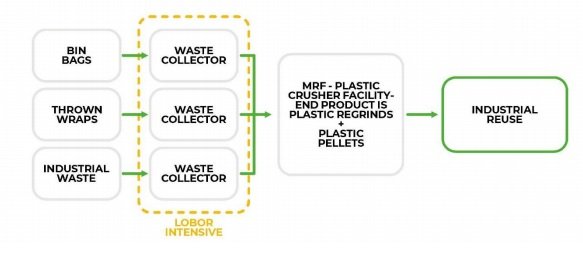
Using blockchain and DApps, Plastic Finance can streamline the recycling business flow and empower scavengers so they get better care for their hard work. Plastic Finance will create an app that scavengers can use to sell their waste to MRF, exchange it for cash or store it as an asset in the form of grind stable coins that can be pledged on our DeFi platform.
What is PLAS Token?
PLAS is the native token of the Plastic Finance ecosystem. PLAS was created to fund the Recycling project and serves as a governance and ownership token for earning student dividends or profit sharing from recycling and DeFi transactions, Internal Exchange spreads.
Plastic Finance will collect a 5% fee from the price of the plastic internal exchanger spread, and a 0.175% fee from a savings withdrawal transaction or loan payment on the DeFi platform. All these fees will be collected in the wallet and using a smart contract, can be distributed regularly.
Plastic Finance collects 60% of its net profit annually from the cooperative’s recycling business. In turn, Plastic Finance will distribute costs and profit sharing as dividends to PLAS holders.
How the Platform Works
Plastic Finance works in two ways: empowering the waste community (such as scavengers, scavengers, etc.) and rewarding those involved in the network. Scavengers will be rewarded for their contributions, where they have the option to earn money in tokens or fiat (real) money. If they prefer crypto tokens, they can actually take part in the platform. They can use this platform to gain access to finance, and this is rare because the trash community is usually the unbanked. Well, with this platform, these unbanked people can finally enjoy financial access
Tokenomics
- Ticker: PLAS
- Token Type : BEP-20 MainNet
- Token Address : 0xCe34caAEe0b691F8e4098DC31CC8818A1dCcF06A
- Token Sale Address : 0x1800C25a3Ed60B41766B8EE94f40CE05A84407aB
- Total Token Supply : 23,900,000 PLAS
Profit Sharing Scheme
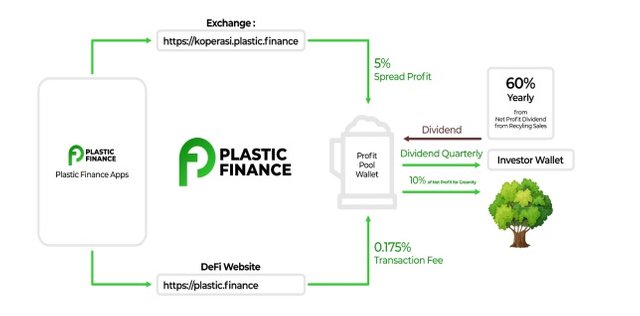
Plastic Finance distributes 10% of our dividend profits for reforestation projects per tonne per day and recycling can be channeled to purchase seedlings of 500-1280 teak trees, which is equivalent to 10Kg of CO2 absorption per year per tree.
Plastic financing through its MRF takes the circular economy flow one step further by dedicating a program of planting a certain amount of trees (in collaboration with certified growers organizations such as SINERGI FOUNDATION) for every amount of plastic recycled so token holders will simultaneously address 3 issues in at the same time, namely recycling plastic waste, scavenging communities & financial inclusion and carbon sequestration through tree planting
One tree can contribute to the absorption of 10Kg of Co2 per year, so the initiative will contribute to the potential for Decarbonization of 21,000-40,000 tons of CO2 during 3 years of operation.
pledged as assets

Tokenomics
- Ticker: PLAS
- Token Type : BEP-20 MainNet
- Token Address : 0xCe34caAEe0b691F8e4098DC31CC8818A1dCcF06A
- Token Sale Address : 0x1800C25a3Ed60B41766B8EE94f40CE05A84407aB
- Total Token Supply : 23,900,000 PLAS
Profit Sharing Scheme
Plastic Finance distributes 10% of our dividend profits for reforestation projects per tonne per day and recycling can be channeled to purchase seedlings of 500–1280 teak trees, which is equivalent to 10Kg of CO2 absorption per year per tree.
Plastic financing through its MRF takes the circular economy flow one step further by dedicating a program of planting a certain amount of trees (in collaboration with certified growers organizations such as SINERGI FOUNDATION) for every amount of plastic recycled so token holders will simultaneously address 3 issues in at the same time, namely recycling plastic waste, scavenging communities & financial inclusion and carbon sequestration through tree planting
One tree can contribute to the absorption of 10Kg of Co2 per year, so this initiative will contribute to the potential for Decarbonization of 21,000–40,000 tons of CO2 during 3 years of operation.

RECYCLE, RECYCLE — USE, PROSPER
1 PLAS Token = 6.4 Tons of Recycled Plastic/Year.
MISSION
1. We promote a circular economy by improving the recycling system
Plastic Finance focuses on plastic recycling by increasing the productivity of scavengers. We do not disrupt the waste value chain; instead, we add value to the value chain to benefit all parties. In addition, we support a tree replanting program to remove carbon from CO2 pollution, further strengthening our commitment to a circular economy.
2. We empower the waste community so that they have a higher social status in society
Plastic Finance aims to empower the waste community. We focus on activities that will increase their self-esteem, which increases their productivity and well-being.
3. We democratize access to ESG investments
Our efforts to enrich the recycling system and empower the waste community can be sustained and expanded with the help of the investment community. With DApps and DeFi, we are democratizing access for everyone to take part in the global mission of recycling and empowering
Conclusion
Plastic Finance focuses on plastic recycling by increasing the productivity of scavengers. Plastic Financing does not disrupt the waste value chain; instead, they add value to the value chain to the benefit of all parties. In addition, we support a tree replanting program to remove carbon from CO2 pollution, further strengthening our commitment to a circular economy.
Project Information:
️Website: https://plastic.finance
️Official Twitter: @Plastik _Finance
️Whitepaper: https://plastic.finance/whitepaper.pdf
️Official Telegram: https://t.me/plasticfinance
️Facebook: https://www.facebook.com/plastic.finance/
️Linkedin: https://www.linkedin.com/company/plastic-finance
️Youtube: https://www.youtube.com/channel/UCxZvaGVdcOJ-_SnGaEn4kew
Username: Sukabumie Link: https://bitcointalk.org/index.php?action=profile;u=3198758
#Plastic #Finance, #ESG #According to #plastic financing #plastic #bitcoin #ico #investment #pollution #waste #plastic waste #environment
 CRYPTOCHONOD